
Switching to solar is no longer a luxury, it has become a smart financial decision for both housing societies and row houses across India. With rising electricity tariffs and improved government subsidies, more people want to know the Best Solar Panel Options for Societies and Row Houses in India.
Whether you’re managing a residential complex or planning solar for an independent home, this guide breaks everything down in a clear, simple way.
Understanding Solar Energy Needs in Indian Societies & Row Houses
The adoption of solar energy is decisive for Indian societies and row houses, offering a path to energy independence and noteworthy cost savings due to plentiful sunlight.
Societies benefit by powering common utilities like elevators and water pumps, severely reducing high common area electricity bills. Row houses, though often having limited roof space, can still leverage solar power through ground-breaking solutions like shared systems or vertical installations.
Despite challenges like high preliminary investment and regulatory complexities, government subsidies and long-term financial returns make solar a sustainable and progressively essential residential energy solution in India.
Solar needs vary suggestively depending on the building type. Societies require large-scale installations, while row houses prefer personal rooftop systems. Let’s break down both.
Power Consumption Patterns in Indian Societies
Power consumption patterns in Indian societies and apartments are characterised by noteworthy seasonal and regional variations, driven mostly by weather and appliance ownership.
Large residential societies often consume high electricity due to:
- Lifts and elevators
- Water pumps
- Security systems
- Parking area lighting
- Clubhouse, gym, and community facilities
Daily requirements often reach 50 kW to 200 kW, making centralized solar systems a great fit.
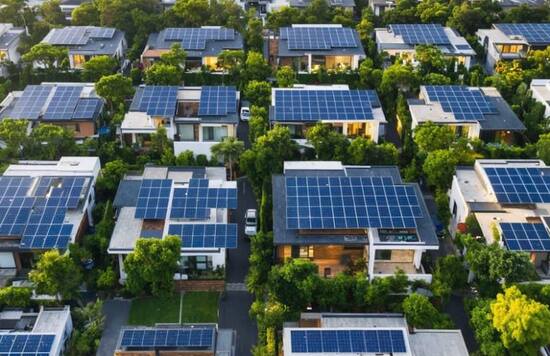
Power Requirements in Indian Row Houses
The power requirements for Indian row houses vary meaningfully based on size, climate, and the household’s socio-economic status, classically ranging from a running load of 2 kW to over 5 kW.
This variability requires a customized approach for solar panel or backup system sizing, straight linking the required capacity to the number of cooling/heating appliances used concurrently.
Row houses typically use:
- Fans, lights, and appliances
- Refrigerators
- Air conditioners
- Water heaters
Average houses need 3 kW to 10 kW rooftop systems. This usage is easily managed with residential solar setups.
Types of Solar Panels Available in India
The Indian market is conquered by three main types of solar panels: Monocrystalline, Polycrystalline, and the newer, high-efficiency PERC/Bifacial technologies.
- Monocrystalline panels (Mono-Si) are the most efficient, offering a sleeker, black appearance and are ideal for rooftops with limited space despite their higher upfront cost.
- Polycrystalline panels (Poly-Si) are more budget-friendly, have a characteristic bluish hue, but are less efficient, making them suitable for installations where the roof area is not a constraint.
- The industry is rapidly shifting towards advanced Mono PERC (Passivated Emitter and Rear Cell) and Bifacial modules, which offer superior performance in India’s hot climate and can generate power from both sides, maximising output.
Major domestic manufacturers like Waaree Energies, Adani Solar, and Tata Power Solar ensure a robust supply chain, offering consumers a wide range of options that are certified to Indian standards.
India offers three primary types of solar panels. Let’s explore them.
Monocrystalline Solar Panels
These panels deliver the highest efficiency, usually between 18%–22%. They’re ideal for:
- Limited rooftop space
- High-energy families
- Long-term solar goals
Polycrystalline Solar Panels
A bit cheaper but slightly less efficient, polycrystalline panels work great for:
- Budget-focused homes
- Larger societies
- Open rooftops with plenty of space
Thin-Film Solar Panels
Though less common, thin-film panels are suitable for:
- Low-light regions
- Temporary structures
- Industrial rooftops
Best Solar Panel Options for Societies in India
The best solar panel options for housing societies in India are classically high-efficiency Monocrystalline and advanced PERC/Bifacial modules due to the necessity to maximize power generation on limited shared rooftop space.
Societies chiefly install on-grid systems for powering mutual utilities like lifts, water pumps, and corridor lighting, leveraging Net Metering to feed surplus power back to the grid and severely reduce the society’s common area electricity bill.
Given the hot Indian climate, panels with greater performance in high temperatures and features like Half-Cut Cells, which mitigate the impact of shading and heat, are preferred for a consistent, long-term return on investment (ROI).
Housing societies require reliable large-scale solutions.
Centralized Solar Power Plants for Societies
Societies benefit most from centralized plants due to:
- Shared cost
- Large collective savings
- Reduced maintenance load
- Higher system durability
On-Grid Solar System for Societies
This is the most common choice because:
- No batteries required
- Lower maintenance
- Unlimited grid backup
Power goes directly into the society’s load, and excess feeds the grid.
Hybrid Solar System for Societies
Hybrid systems offer:
- Backup during power cuts
- Grid support
- Smart power management
These are ideal for areas with frequent outages.
Top Panel Brands for Societies
When it comes to large installations, trusted Indian brands include:
- Tata Power Solar
- Vikram Solar
- Waaree Energies
- Adani Solar
Best Solar Panel Options for Row Houses in India
For Indian row houses, the high-efficiency Monocrystalline and Mono PERC (Passivated Emitter and Rear Cell) panels are usually the wider choice, as they maximize energy generation in the often limited rooftop space available.
Row houses usually opt for on-grid solar systems to offset high monthly bills, utilizing the higher efficiency of Mono PERC panels (typically> 20%) efficiency) to produce more electricity per square meter.
While Polycrystalline panels are more budget-friendly, their lower efficiency means they require knowingly more roof area to attain the same capacity, which is often a constraint for individual row houses.
Ultimately, the decision balances the higher upfront cost of high-efficiency modules against the long-term benefit of maximum power output from a smaller footprint, leading to better overall savings.
Homes benefit from rooftop systems that save money and add property value.
Rooftop Solar Systems for Row Houses
On-Grid Rooftop Systems
Best for homes with:
- Stable grid connection
- Higher monthly electricity bill
- No need for batteries
Off-Grid Rooftop Systems
These use batteries and work well for:
- Rural homes
- Remote areas
- Properties with frequent outages
Hybrid Rooftop Systems
Hybrid systems combine grid and batteries, offering:
- 24×7 power
- Smart energy use
- Higher efficiency
Recommended Solar Panel Brands for Raw Houses
Top-performing brands include:
- Loom Solar
- Tata Solar
- Adani
- Renewsys
Cost Comparison for Societies vs Raw Houses
| System Type | Approx. Cost (INR) |
| Society Solar Plant (50–200 kW) | ₹25–₹90 lakh |
| Raw House On-Grid (3–10 kW) | ₹1.5–₹5 lakh |
| Raw House Hybrid (3–10 kW) | ₹2.5–₹7 lakh |
| Raw House Off-Grid (3–10 kW) | ₹3–₹8 lakh |
Government’s Solar Panel Subsidies & Policies in India
The Indian government has significantly boosted residential solar adoption with the launch of the PM Surya Ghar: Muft Bijli Yojana (launched in February 2024), which delivers subsidies up to ₹78,000 for systems > 3 kW to encourage $10$ million households to install rooftop solar.
This Central Financial Assistance (CFA) is aimed at reducing the high upfront cost and is completed by the Net Metering policy, which permits homeowners and societies to export excess power back to the grid for bill credits.
Moreover, the scheme promises up to 300 units of free electricity monthly to eligible families, making solar power a progressively attractive and financially viable solution for poor and middle-income families across the country.
The PM Surya Ghar Muft Bijli Yojana offers excellent benefits.
Subsidy Breakdown for Societies
Societies may receive:
- Support for common area load
- Discounted solar infrastructure
- Net metering benefits
Subsidy Breakdown for Raw Houses
For homes:
- Up to ₹78,000 subsidy for a 3 kW system
- Additional benefits for rooftop installations
Maintenance & Lifespan of Solar Panels in India
The lifespan of quality solar panels in India is generally 25 to 30 years, backed by performance warranties that promise they will still produce at least 80% of their original power output by the end of that period.
Maintenance Highlights:
- Routine Cleaning: The key maintenance requirement in India is recurrent cleaning (naturally 2-4 times a year, or monthly in dusty regions) due to high levels of dust and pollution, which can reduce efficiency by up to 20%.
- Minimal Effort: Since panels have no moving parts, the maintenance is low-effort, mostly requiring visual checks and professional annual inspections to test the electrical components and the health of the inverter (which has a shorter lifespan of 8-12 years).
- Longevity Factors: Longevity is vastly dependent on addressing mutual issues like hot spots (caused by dirt or shading), loose wiring due to weather exposure, and ensuring the system is accurately monitored.
Cleaning Requirements
Dust accumulates easily in India. Cleaning every 15–20 days helps maximize efficiency.
Performance Monitoring Systems
Smart apps allow users to track daily:
- Units generated
- System health
- Monthly savings
Understanding the Three Solar Models for Societies
There are three different solar system configurations that societies can choose from:
| Solar Model | How It Works | Best For |
| Rooftop Solar | Solar panels are installed on the society’s rooftop and supply power to common areas. | Housing societies with sufficient and structurally sound rooftop space. |
| Shared Solar Grid | Members share an off-site solar plant and receive bill credits as per contractual agreement | Societies with limited or no rooftop space for solar installations. |
| Hybrid System | Combines rooftop solar, grid electricity, and battery backup to provide consistent power. | Societies that seek both redundancy and the benefits of solar + grid power. |
Community solar is extra option for society members to have the benefit of a single solar installation. The shared solar gardens typically do this on leased land, and deliver credits to electricity bills according to share ownership.
The society must think prudently about its energy circumstance, energy budget within constraints and considerations, and the genuine roof conditions before selecting the system best suited for the requirements of the society.
Comparing Rooftop vs Shared Grid vs Hybrid Models
Associating solar energy options for societies means looking at how much they cost, how consistent they are, and what kind of maintenance they essential. Let’s get into how these systems match up against each other.
Cost Comparison: Original Investment
| Model | Average Cost per kW | Government Subsidy | After Subsidy (10kW Example) |
| Rooftop Grid-Tied | ₹50,000–₹70,000 | Up to 40% | ₹3 lakh (from ₹5 lakh) |
| Off-Grid | ₹1 lakh–₹1.5 lakh | Limited | ₹10–₹15 lakh |
| Hybrid | ₹80,000–₹1 lakh | Partial | ₹8–₹10 lakh |
Reliability and Performance
Each model brings its own reliability advantages:
| System | Works During Grid Outage? | Energy Source | Reliability Rating |
| On-Grid | No | Solar + Grid | Moderate |
| Off-Grid | Yes | Solar + Batteries | High (if managed well) |
| Hybrid | Yes | Solar + Grid + Batteries | Very High |
Maintenance and Long-Term Costs
Types of solar system need different levels of care:
| System | Maintenance Needs | Battery Replacement | Annual Cost |
| Grid-Tied | Low (Cleaning + Inspection) | No | ₹5,000–₹10,000 |
| Off-Grid | High (Battery upkeep) | Yes (every 5–7 years) | ₹15,000+ |
| Hybrid | Medium to High | Yes (partial replacement) | ₹10,000–₹20,000 |
Return on Investment
| System | Bill Reduction | Breakeven Period | Subsidy Impact |
| Grid-Tied | Up to 90% on common area | 4–5 years | High (up to ₹90 lakh for large systems) |
| Off-Grid | 100% energy independence | 7–10 years | Moderate |
| Hybrid | 90–100% + backup | 5–7 years | Moderate to High |
Which Solar Model is Best for Your Society?
The ideal renewable energy path for your society depends on many important factors that only your community will know. Your limitations in budget and need for reliability in terms of energy is a huge factors. You will essential to study your own situation sensibly to determine the best path.
How to Choose the Best Solar Panel Option in India
Choosing the best solar panel in India hinges on maximizing efficiency within accessible roof space and aligning with your budget after considering government subsidies.
Key Considerations:
- Space vs. Efficiency: For limited space (common in row houses and societies), Monocrystalline or Mono PERC panels are greater, offering higher power output per square foot despite a higher initial cost.
- Budget vs. Output: If rooftop space is plentiful and the budget is tighter, Polycrystalline panels are the more reasonable option, although they have lower efficiency and necessitate more area to accomplish the same capacity.
- Quality and Warranty: Always prioritize panels from Tier 1 manufacturers with a minimum of 25-year performance warranties and ensure that the solar panel installer is registered under the PM Surya Ghar Yojana to benefit from the noteworthy government subsidies.
Ultimately, the optimal choice is a high-quality system that balances efficiency with the total system cost, including the benefit of Net Metering for the fastest return on investment (ROI).
Efficiency and Warranty
Choose brands offering:
- Minimum 25-year performance warranty
- High efficiency (>19%)
Roof Space & Load Capacity
Always inspect:
- RCC strength
- Shadow-free area
- Orientation
Inverter Compatibility
A high-quality inverter increases energy output significantly.
FAQs On Best Solar Panel Options for Societies and Raw Houses in India
-
Which solar panel is best for societies?
Monocrystalline panels from Tata or Waaree offer high efficiency and reliability.
-
What is the best option for a raw house?
On-grid rooftop systems are the most affordable and efficient.
-
How much does solar installation cost in India?
Costs range from ₹1.5 lakh (home) to ₹90 lakh (society).
-
Can societies install solar under subsidy?
Yes, many states offer special support for common area solar plants.
-
Which panel lasts the longest?
Monocrystalline panels typically last 25–30 years.
-
Is hybrid solar good for homes?
Yes, if you need power backup along with grid savings.
In Conclusion :
Choosing the Best Solar Panel Options for Societies and Raw Houses in India depends on your energy usage, budget, and location. Societies benefit from centralized on-grid or hybrid systems, while raw houses can choose rooftop systems that offer incredible long-term savings. Solar energy isn’t just an upgrade, it’s the future of sustainable living in India.


