
India’s solar story is no longer just about rooftop panels on individual homes; ground-mounted solar farms are at the centre of the country’s clean-energy surge. As of mid-2025, India’s increasing solar capacity has ascended intensely, with the vast majority coming from ground-mounted installations.
This change isn’t accidental: falling module prices, helpful policy, corporate demand, and massive land-use possibilities have all combined to make ground-mounted solar vastly prevalent across states and project types in India.
Why Ground-mounted Solar is Growing so Fast in India?
-
Scale & speed of deployment
Ground-mounted plants, utility-scale parks and bigger commercial/industrial (C&I) installations permit developers to deploy megawatts rapidly, benefiting from economies of scale that rooftop projects hardly achieve. Current capacity add-ons display solar deployment surging, mainly driven by ground projects.
-
Land availability and mapped potential
Government mapping and state-level assessments (including MNRE maps of ground-mounted PV potential) have made it easier to classify appropriate zones, deserts, wastelands, fallow agricultural land and disused industrial sites an accelerating project planning and approvals. India’s technical potential for ground-mounted PV is huge and spread across numerous states.
-
Policy, tenders and corporate demand
Large tenders, renewable purchase obligations (RPOs), and corporate green-power procurement have created expected demand. Central and state policies (land allotment mechanisms, viability gap funding in early years, power-purchase frameworks) endure to favour ground projects for meeting big capacity targets.
-
Technological & cost improvements
Module price declines, better trackers, bifacial modules and enhanced mounting systems have elevated yields for ground arrays (particularly with single-axis trackers), making ground installations more attractive on a $/kWh basis over project lifetimes.
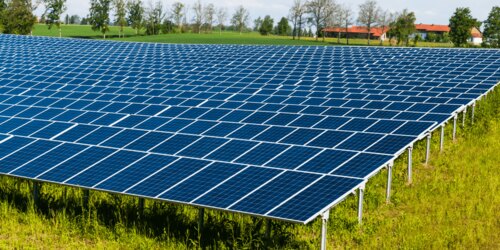
Major Use Cases: Where Ground-mounted Wins
- Utility-scale solar parks: Large solar parks (tens to thousands of MW) feed the grid and are the backbone of national capacity growth. These projects are perfect for meeting state and central targets quickly.
- Commercial & industrial (C&I) plants: Factories, warehouses and campuses with end-to-end land favour ground-mounts for scale, easier maintenance, and greater orientation.
- Agrivoltaics and hybrid land use: Combining crops with elevated ground arrays (agrivoltaics) is an emerging trend to use farmland productively while generating power. Pilot projects and research are expanding in interest.
Advantages of Ground-mounted Systems
- Optimal orientation & higher yields: Panels can be oriented and tilted for supreme irradiation; trackers further upsurge energy output.
- Easier maintenance and access: Ground arrays are easier to inspect, clean and service than several rooftops.
- Economies of scale: Lower per-W installation costs for big projects and competitive tariff discovery in tenders.
- Flexibility for future upgrades: Easier to expand, retrofit trackers, or add storage at ground sites than on roofs.
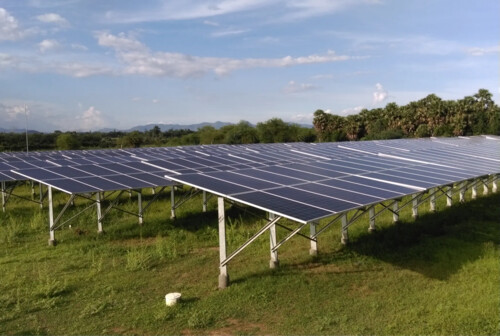
Challenges & Trade-offs
- Land use and social acceptance: Large ground projects necessitate land; conflicts over agricultural land, displacement, or ecological influence can arise. Cautious site selection, use of degraded/wasteland, and community engagement are vital.
- Transmission & evacuation costs: Utility-scale plants often prerequisite grid strengthening and evacuation infrastructure, which can add to project cost and timelines.
- Higher upfront civil and mounting costs vs rooftops: While per-kWh economics can be improved at scale, initial civil works and fencing raise upfront costs compared with rooftop installs.
- Regulatory & environmental clearances: Ground projects sometimes face stricter clearances (environmental, forest, local approvals), depending on location.
Innovations helping ground-mount adoption
- Trackers & bifacial modules: Increase energy yield per panel and progress land-use efficiency.
- Floating solar (as an alternative): In water-scarce or land-constrained areas, floating PV on reservoirs offers a complementary route, sometimes coupled with existing hydro infrastructure.
- Agrivoltaic designs: Raised or spaced arrays that permit crops beneath to aid combine power and food production, an appealing model where farmland must be preserved.
State-level hotspots & recent momentum
Several states (Rajasthan, Gujarat, Maharashtra, Andhra Pradesh, Tamil Nadu, Karnataka) have large ground-mounted pipelines and mapped latent state policies, waste-land inventories and caring outcomes often govern where the next big parks appear.
India’s mid-2025 data shows a noteworthy ground-mounted share of national solar capacity and record add-ons in recent months, underscoring a fast drive.
What this means for India’s energy future
Ground-mounted solar is the workhorse of India’s energy transition: it brings bulk capacity swiftly, enables corporate renewable procurement at scale, and unlocks region-specific potential identified by MNRE and research bodies.
As transmission upgrades, storage adoption and smarter land policies advance, ground projects will continue to be central to meeting India’s renewable targets and decarbonization goals.
Quick Takeaways
- Ground-mounted solar dominates India’s recent capacity additions and will likely continue to lead new installations.
- The model is attractive for large power needs and corporate buyers because of higher yields, scale economies and easier maintenance.
- Managing land, ecological and social impacts, plus grid integration, remain key challenges to be addressed through policy and technology.
FAQs on Ground-Mount Solar Panels in India
Q: Are ground-mounted systems cheaper than rooftop?
Not necessarily in upfront cost — ground projects incur civil, fencing and land-prep costs — but at scale, their levelized cost of energy (LCOE) often becomes more competitive than small rooftop systems.
Q: Can agriculture coexist with ground-mounted solar?
Yes, agrivoltaics and raised installations are promising approaches being piloted to combine farming and power generation. Site-appropriate designs are essential.
Q: Will ground-mounted solar keep growing in India?
All indicators (policy support, mapped potential, recent tender and addition data) point to continued growth, especially for utility and large C&I projects, though the exact pace depends on grid upgrades, land policy and financing.
Conclusion
Ground-mounted solar panels are more than a momentary trend in India. They’re a strategic tool for rapid decarbonization, energy security, and meeting large-scale demand. With supportive policies, technological improvements and careful land planning, ground-mounted solar is likely to remain a dominant force in India’s renewable energy mix for years to come.


