Industrial electricity costs in India are rising steadily, and factories are under continuous pressure to decrease operating expenses while meeting sustainability goals. One of the most effective solutions gaining thrust is Industrial Solar Rooftop for Factories & Industrial Buildings in India.
By utilizing unused rooftop space, industries can produce clean, reasonable power and gain superior control over their energy needs.
India’s strong solar potential, supportive government policies, and falling solar technology costs make rooftop solar a clever investment for industrial and manufacturing units.
This article discovers how industrial solar rooftop systems work, their benefits, costs, policies, and why they are becoming vital for factories across India.
What Is an Industrial Solar Rooftop System?
An industrial solar rooftop system is a photovoltaic (PV) power plant installed on the roof of factories, warehouses, or industrial buildings. These systems convert sunlight into electricity that can be used straight within the facility.
An Industrial Solar Rooftop System in India is no longer just an alternative energy source but a core financial and operational strategy for factories. These systems comprise installing high-efficiency photovoltaic (PV) modules on factory sheds to convert India’s plentiful sunlight into serviceable electricity, directly offsetting expensive industrial grid power.
Key Components of the System
- Tier-1 Solar Panels: High-efficiency Monocrystalline or Bifacial panels are standard for industrial setups due to their superior performance in varied Indian climates.
- Industry-Grade Inverters: String or central inverters convert DC to AC power and are integrated with AI-enabled monitoring to track real-time generation and fault detection.
- Robust Mounting Structures: Precisely engineered to endure high wind speeds and the heavy load of industrial rooftops without compromising the building’s structural integrity.
- Net Metering Infrastructure: A bi-directional meter that permits factories to feed surplus power back to the grid on weekends or holidays, earning credits on their monthly bills.
Key Components of the Solar System
- Solar Panels: Capture sunlight and convert it into DC power
- Inverters: Convert DC power into usable AC electricity
- Mounting Structures: Secure panels on rooftops
- Net Metering System: Allows export of excess power to the grid
- Monitoring Systems: Track performance and energy generation
Industrial systems are usually larger than residential ones, ranging from 100 kW to several MW, depending on roof size and energy demand.
Why Industrial Solar Rooftop Is Ideal for Factories in India?
Industrial solar rooftop systems are quickly becoming a cornerstone for Indian factories due to their ability to transform underutilized roof space into a high-yield financial asset.
With India’s high solar irradiance and the rising cost of industrial grid tariffs often ranging between ₹8 and ₹12 per unit, solar power offers a noteworthy hedge against inflation and operational overheads.
Factories in India operate during daytime hours, which flawlessly aligns with solar energy generation. This makes solar rooftops particularly efficient for industrial use.
Why It Is Ideal for Indian Factories
- Drastic Cost Reduction: Factories can slash their electricity bills by 60% to 80%. Given that industries are energy-intensive, these savings directly improve the bottom line and allow for reinvestment into core operations.
- Rapid ROI & Long-term Benefits: The typical payback period for industrial solar in India is just 3 to 5 years. After this period, the factory enjoys virtually free electricity for the remainder of the system’s 25-year lifespan.
- Tax & Financial Incentives: The Indian government provides “Accelerated Depreciation” benefits, allowing businesses to claim up to 40% depreciation in the first year. Additionally, MSMEs can benefit from various state-level subsidies and easier access to low-interest green financing.
- Operational Resilience: By reducing dependence on the national grid, factories are less vulnerable to power fluctuations and outages. When paired with battery storage or hybrid systems, solar ensures consistent uptime for critical machinery.
- ESG and Global Competitiveness: Adopting solar helps companies meet Environmental, Social, and Governance (ESG) targets. For exporters, having a “Green” certification is increasingly becoming a prerequisite to working with global partners and attracting international investment.
Major Reasons for Adoption
- High daytime electricity consumption
- Large, unused rooftop areas
- Rising grid electricity tariffs
- Increasing ESG and sustainability compliance
- Government incentives and net metering benefits
Key Benefits of Industrial Solar Rooftop for Factories & Industrial Buildings in India
Adopting industrial solar rooftop systems is one of the most effective ways for Indian factories to reduce operational overheads while future-proofing their energy needs.
With India’s average of 300 sunny days a year and high industrial electricity tariffs, the transition to solar is no longer just an environmental choice, it is a strategic financial move.
Massive Operational Cost Savings
Industrial electricity tariffs in India are among the highest in the world, often ranging from ₹8 to ₹12 per unit. Solar energy allows factories to slash these bills by 60% to 80%. Once the system is installed, the cost per unit of electricity is effectively locked in for 25 years, protecting the business from the frequent tariff hikes of state DISCOMs.
High ROI and Accelerated Depreciation
The typical payback period for industrial solar in India is remarkably short, usually between 3 and 5 years. Beyond the direct savings, the Indian government provides a significant tax shield through Accelerated Depreciation. This allows businesses to claim up to 40% depreciation on solar equipment in the first year, drastically reducing taxable income.
Improved Energy Reliability
Factories often suffer from grid fluctuations and unscheduled power cuts, which can lead to expensive machinery downtime. Solar systems—especially when paired with Battery Energy Storage Systems (BESS)—provide a consistent and stable power supply. This reduces reliance on expensive, polluting diesel generators (DG sets), which can cost ₹18 to ₹25 per unit to operate.
ESG Compliance and Global Competitiveness
As global supply chains shift toward sustainability, Indian exporters are increasingly required to demonstrate low carbon footprints. Adopting solar helps factories meet Environmental, Social, and Governance (ESG) targets and secure green certifications (like LEED). This enhances brand reputation and makes the company more attractive to international buyers and investors.
Efficient Use of Idle Real Estate
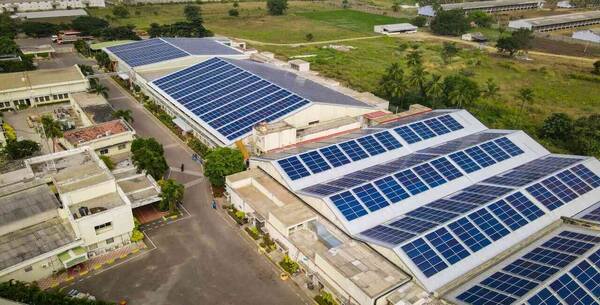
Most Indian factories have expansive, flat, or slanted RCC/metal rooftops that remain underutilized. Solar installations turn this “dead space” into a productive asset without requiring additional land acquisition. Furthermore, the panels act as an extra layer of insulation, reducing the temperature inside the factory shed and lowering the load on air conditioning systems.
Significant Reduction in Electricity Costs
Industrial power tariffs are among the highest in India. Solar rooftops can reduce electricity bills by 30%–70%, depending on system size and consumption.
Fast Return on Investment (ROI)
Most industrial solar rooftop systems achieve ROI within 3–5 years, while system life exceeds 25 years.
Energy Independence
Solar reduces reliance on grid power and protects factories from power outages and tariff hikes.
Environmental Sustainability
Using solar power helps industries lower carbon emissions and meet sustainability targets.
Enhanced Corporate Image
Factories using renewable energy strengthen their brand reputation and meet global ESG standards.
Types of Industrial Solar Rooftop Systems in India
On-Grid Solar Rooftop
- Connected to the electricity grid
- Uses net metering
- Most popular choice for factories
Off-Grid Solar Rooftop
- Independent of the grid
- Requires batteries
- Suitable for remote industrial locations
Hybrid Solar Systems
- Combination of grid and battery backup
- Ensures uninterrupted power supply
Installation Capacity and Roof Requirements
| Factory Roof Area | Approx. Solar Capacity |
| 10,000 sq. ft. | 100 kW |
| 50,000 sq. ft. | 500 kW |
| 1 lakh sq. ft. | 1 MW |
Key roof considerations include:
- Structural strength
- Shadow-free space
- Roof orientation and tilt
Government Policies and Incentives for Industrial Solar in India
India strongly supports rooftop solar adoption.
Key Policy Benefits
- Net metering regulations
- Accelerated depreciation (up to 40%)
- Subsidies for select sectors
- State-level incentives
For official guidelines, industries can refer to the Ministry of New and Renewable Energy (MNRE) website: https://mnre.gov.in
Power Purchase Models for Industries
CAPEX Model
- Factory invests upfront
- Maximum long-term savings
- Best ROI
OPEX / RESCO Model
- Zero upfront cost
- Pay per unit of solar electricity
- Ideal for cash-flow-sensitive businesses
Common Challenges and Solutions of Industrial Solar in India
Roof Strength Issues
Solution: Structural audits and lightweight mounting systems
Approval Delays
Solution: Work with experienced EPC providers
Maintenance Concerns
Solution: Annual maintenance contracts (AMC) and monitoring systems
FAQs On Industrial Solar Rooftop for Factories & Industrial Buildings in India
-
Is industrial solar rooftop suitable for all factories?
Yes, most factories with sufficient roof space and daytime energy use can benefit.
-
How long does installation take?
Typically 6–10 weeks, depending on system size and approvals.
-
Can excess solar power be sold to the grid?
Yes, through net metering, subject to state regulations.
-
What is the lifespan of solar panels?
Panels usually last 25–30 years with minimal degradation.
-
Does solar affect factory operations?
No, installation is planned to avoid disruption to daily operations.
-
Is maintenance expensive?
No, maintenance costs are low, usually 1–2% of system cost annually.
Future of Industrial Solar Rooftop in India
With India targeting 500+ GW of renewable energy by 2027, industrial solar rooftops will play a critical role. Advances in panel efficiency, energy storage, and smart monitoring will make solar even more attractive for factories and industrial buildings.
Industries adopting solar today will gain a competitive advantage tomorrow through lower costs, energy security, and sustainability leadership.
In Conclusion:
Industrial Solar Rooftop for Factories & Industrial Buildings in India is no longer just an alternative, it is a strategic necessity. By leveraging abundant sunlight, supportive policies, and proven technology, factories can reduce costs, enhance sustainability, and future-proof their operations.
For industrial units aiming to remain competitive, resilient, and environmentally responsible, investing in solar rooftop systems is a smart and forward-looking decision.